


Winter Ground Conditions in UAE: How Rough-Terrain Cranes Perform Better on Desert & Remote Sites
Winter in the UAE is often framed as a “quiet season” cooler air, calmer schedules, and fewer heat restrictions. On site, however, it can be the opposite. Winter is when ground behavior becomes unpredictable: shallow rain events, localized runoff, and fluctuating compaction can turn stable-looking sand into a variable foundation that challenges conventional lifting plans. For contractors booking crane rental Dubai for projects that extend beyond paved environments desert parcels, utility corridors, and remote industrial pads, winter is the season that reveals whether a crane is merely mobile or truly site-capable.
Winter Ground Reality: Low Rainfall, High Consequence
The UAE remains arid overall, but winter concentrates much of the year’s precipitation into a short period. Climate references consistently show that Dubai’s wetter window clusters roughly between January and March, with February often recording the highest rainfall, while the remainder of the year remains largely dry. This pattern matters because construction ground conditions respond nonlinearly: even modest rainfall can soften near-surface layers, reduce shear strength, and introduce differential settlement under outrigger pads—especially where sand grading is inconsistent or where clay lenses exist beneath fill.
In practice, “winter ground” in the UAE is rarely muddy in the obvious sense. It is more subtle and therefore more dangerous: a thin moisture layer that appears dry by mid-morning but remains mechanically compromised beneath the surface. This is the point at which a lift plan either respects ground bearing capacity or becomes a case study in incident reporting. Best-practice guidance for outrigger loading consistently emphasizes that stability depends on accurate ground assessment and correct mat sizing, as ground failure remains a leading cause of crane-related incidents when loads are high and bearing areas are underestimated.
Why Rough-Terrain Cranes Win When the Surface Lies
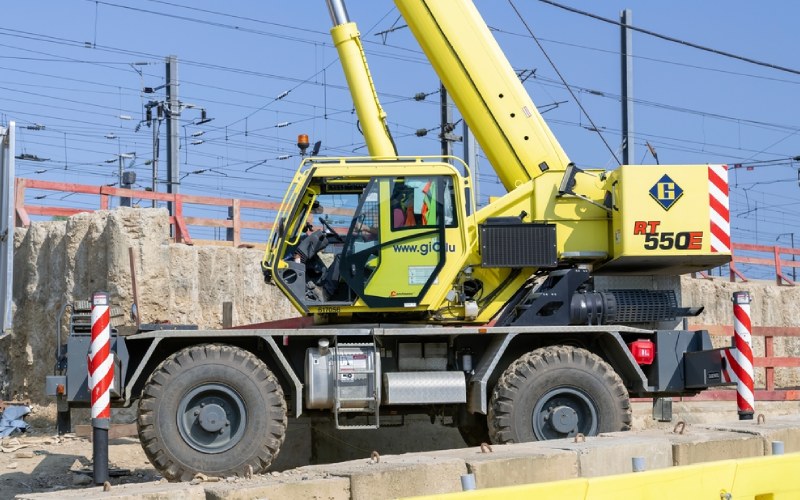
Rough-terrain cranes are not simply conventional cranes fitted with larger tyres. They are engineered specifically for the type of off-road variability common during UAE winters: loose sand, rutted access routes, uneven compaction, and rapidly changing bearing strength over short distances. The advantage begins with basic physics. Large, deep-tread tyres distribute weight more effectively and improve traction, while four-wheel drive and multiple steering modes maintain control when access roads resemble tracks rather than finished pavement. Technical specifications for modern rough-terrain cranes consistently highlight these features, alongside integrated load-moment systems designed to keep operations within safe parameters.
The true differentiator, however, is setup resilience. Rough-terrain cranes typically feature independently adjustable hydraulic outriggers that allow precise leveling on uneven ground without excessive corrective ground works. In winter conditions where one outrigger may rest on firm compacted gravel and another on softened sand this adaptability is not merely beneficial; it is operational insurance.
Stability, Load Control, and the Analytics That Matter
Winter productivity losses rarely stem from full stoppages. More often, they result from cumulative micro-delays: re-positioning, re-matting, re-leveling, and repeated radius verification following settlement. Each adjustment consumes minutes, and across a project lifecycle, those minutes compound into lost days. Experienced operators monitor these hidden costs through setup duration, frequency of re-leveling, and the number of unplanned ground interventions. Within this framework, rough-terrain cranes frequently outperform alternatives by minimizing corrective actions and maintaining consistent lift geometry throughout the working shift.
Safety data reinforces this advantage. Load-moment indicators restrict operating envelopes dynamically as conditions change, reducing the likelihood of overload scenarios—particularly on uneven or compromised ground where true stability margins are reduced. When combined with winter wind variability and shorter daylight hours, disciplined control systems become increasingly valuable, as operational decisions are made under tighter time and safety constraints.
Remote Work Is a Logistics Problem Before It Is a Lift Problem
Remote sites magnify inefficiency. Every additional ground solution, extra steel plates, expanded mat inventories, or secondary equipment for pad preparation adds logistical complexity. Where access roads are temporary or partially formed, selecting the wrong crane initiates a cascade of consequences: increased transport movements, additional handling, higher standby exposure, and greater schedule volatility. Rough-terrain cranes mitigate these risks by arriving ready to operate on unprepared ground and moving within the site without the coordination burden required by less agile machines.
This reality explains why contractors increasingly specify rough terrain crane rental for winter desert programs. The value lies not only in lifting capacity, but in maintaining predictable operations when ground conditions cannot be assumed.
UAE winter does not bring snow or frost, but it does bring variable ground mechanics subtle shifts that are easy to dismiss until they disrupt a lift. Rough-terrain cranes outperform in this season because they are designed for uncertainty: traction, leveling flexibility, stability systems, and off-road mobility built into the machine rather than improvised on site. The most competitive contractors treat this as strategy: they match equipment to ground reality, not to assumptions drawn from fair-weather conditions.
