


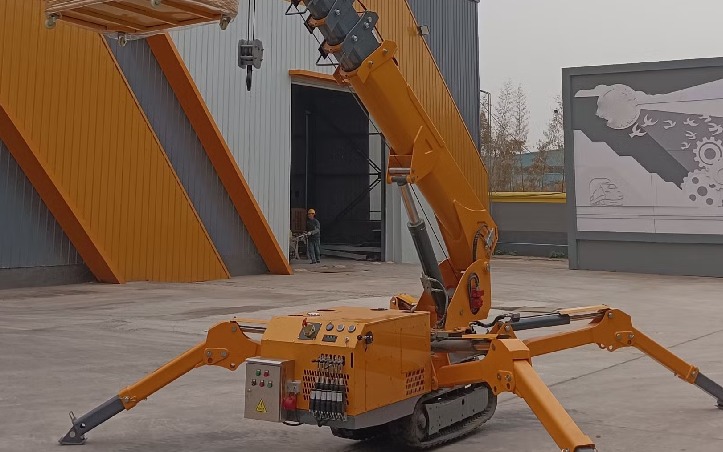
Case Study: Successful High-Rise Installation in Downtown Dubai with Spider Crane Support
Downtown Dubai is one of the most challenging areas in the UAE for construction work. Heavy pedestrian movement, limited access routes, ongoing traffic, and strict regulations make it difficult to use conventional cranes. For façade and MEP installation work at height, the constraint is rarely lifting capacity alone. It is often the ability to position equipment safely, operate within a compact footprint, and maintain disruption control without compromising programme certainty, particularly when spider crane rental capability must be deployed inside dense urban settings.
This case study outlines how we at Safest Lift provided spider crane support for a high-rise installation scope in Downtown Dubai, supplying the equipment and technical execution approach required to manage access constraints, placement accuracy, and sequencing discipline under an active urban operating environment.
Site Access And Space Constraints
The installation scope required lifting prefabricated façade and structural components into position at elevation within a mixed-use tower environment. The surrounding site conditions offered no meaningful laydown zone for large mobile cranes and limited the use of extended outriggers or wide exclusion zones. Access was restricted to service corridors with defined width and loading limits, with movement routes passing adjacent to active public and tenant areas.
These constraints created two immediate requirements. First, equipment needed to enter and operate within tight spatial tolerances. Second, lifting operations had to integrate with live site activities without creating repeated stop-start disruption through frequent mobilisation, reconfiguration, or extended isolation boundaries.
Choosing A Spider Crane For The Project
Following site inspection and engineering review, we selected a spider crane configuration as the primary lifting solution. The decision was based on compact access capability, adaptable outrigger geometry, and the ability to operate within limited slab and podium footprints while maintaining stable lift behaviour.
Engineering evaluation considered ground bearing capacity, outrigger reaction distribution, working radius requirements, and load positioning constraints near the structure. The selected arrangement enabled the crane to be positioned close to the installation zone without triggering road interface controls or requiring external crane siting.
This approach reduced the dependency on authority-sensitive logistics such as lane closures, escort coordination, and extended traffic management measures that often drive programme volatility in Downtown environments.
Lift Sequencing And Planning Approach
A project-specific lifting plan was developed to control sequencing, interfaces, and placement risk. Lift paths were defined to avoid public-facing edges, and staged installation windows were aligned with adjacent trades to reduce congestion and protect critical internal progress.
Rigging checks, exclusion zone management, and communication controls were designed around limited visual angles and tight placement tolerances typical of high-rise façade and MEP installation work. Remote-control operation was used to support better operator positioning, improving sightline control during critical movements and reducing reliance on verbal correction during final alignment.
Micro-positioning capability became a key performance factor, particularly during final placement where tolerance margins were limited and manual intervention needed to be minimised.
Execution Consistency And Site Stability Outcomes
The installation sequence was executed in staged lifts using just-in-time delivery to avoid site crowding and reduce storage exposure. Once positioned, the spider crane remained operationally stable across multiple phases, removing the need for repeated relocation cycles that typically introduce disruption and time loss.
During execution, load behaviour remained consistent, with smooth slew and hoist control supporting accurate placement. No unplanned stoppages were recorded during the lifting scope, and progress remained aligned with the approved sequence.
From a safety perspective, the controlled footprint and reduced requirement for manual correction at height lowered exposure during critical placement stages. The reduced need for external interface controls also limited the number of high-risk interactions between lifting operations and surrounding public movement patterns.
Programme Reliability And Indirect Cost Control
The chosen lifting strategy improved programme predictability by removing common bottlenecks associated with conventional crane deployment in congested urban zones. With no dependency on large-scale mobilisation logistics, the work avoided delays linked to route approvals, extended exclusion planning, and disruption-sensitive authority controls.
Indirect cost reduction was observed through lower traffic management requirements, fewer temporary works provisions, and reduced disruption-driven coordination overhead. Consistent lifting progression also supported downstream sequencing across façade and fit-out activities, reducing knock-on delays and improving overall task continuity.
Lessons For Downtown High-Rise Lifting Strategy
This project reinforced a recurring pattern in dense urban construction: successful lifting is often determined by access, control, and sequencing compatibility rather than maximum capacity. In Downtown environments, compact equipment with stable performance and precise controllability can materially outperform larger systems that cannot be deployed efficiently within the site envelope.
Early engineering involvement was also decisive. By aligning equipment capability with access constraints and sequencing requirements at the planning stage, risk was managed proactively rather than absorbed through reactive on-site adjustments. The Downtown Dubai high-rise installation demonstrates how spider crane support can resolve lifting constraints created by footprint limitation, restricted access, and disruption-sensitive operating conditions. Through disciplined planning, controlled deployment, and precision-led execution, we delivered a lifting solution that protected safety performance, supported programme continuity, and maintained compliance confidence for heavy lifting Dubai scopes operating within highly constrained urban environments.
As high-density development continues to intensify, compact lifting strategies that prioritise controllability and access efficiency will remain central to successful high-rise installation delivery.
